
Mellekis Research
The state of AI adoption in Irish, UK and EU SMEs, 2026: wide, not deep
Official data show AI use among Irish, UK and EU SMEs has risen sharply since 2023, yet few use it to run workflows. Mellekis analyses the depth gap.
 By Gabriel OkochaCo-founder, Mellekis
21 min read
5.4% → 17.2%
Irish small enterprises (10–49 employees) using at least one AI technology, 2023 to 2025
CSO
4.3%
Irish small enterprises using AI to automate workflows or support decisions in 2024 and in 2025, while overall use climbed
CSO
70.9% vs 38.8%
EU small firms that had considered AI but weren't using it: lack of relevant expertise against cost
Eurostat, 2025
59.0%
UK small firms that use AI (or aren't sure) describing their use as "limited"; 12.4% say "extensive"
ONS, Wave 165
AI use among SMEs is still a minority activity, but it is spreading fast. In Ireland, the share of small enterprises (10–49 employees) using at least one AI technology rose from 5.4% in 2023 to 17.2% in 2025, according to the CSO. On Eurostat's harmonised figures, which allow an EU comparison, 16.8% of Irish small enterprises used AI in 2025, slightly below the 17.0% for the EU-27 (up from 6.4% in 2023). In the UK, the ONS reports that 38% of businesses with 10 or more employees (a band that includes large firms) were using at least one AI technology in September 2026, 26 percentage points higher than in September 2023.
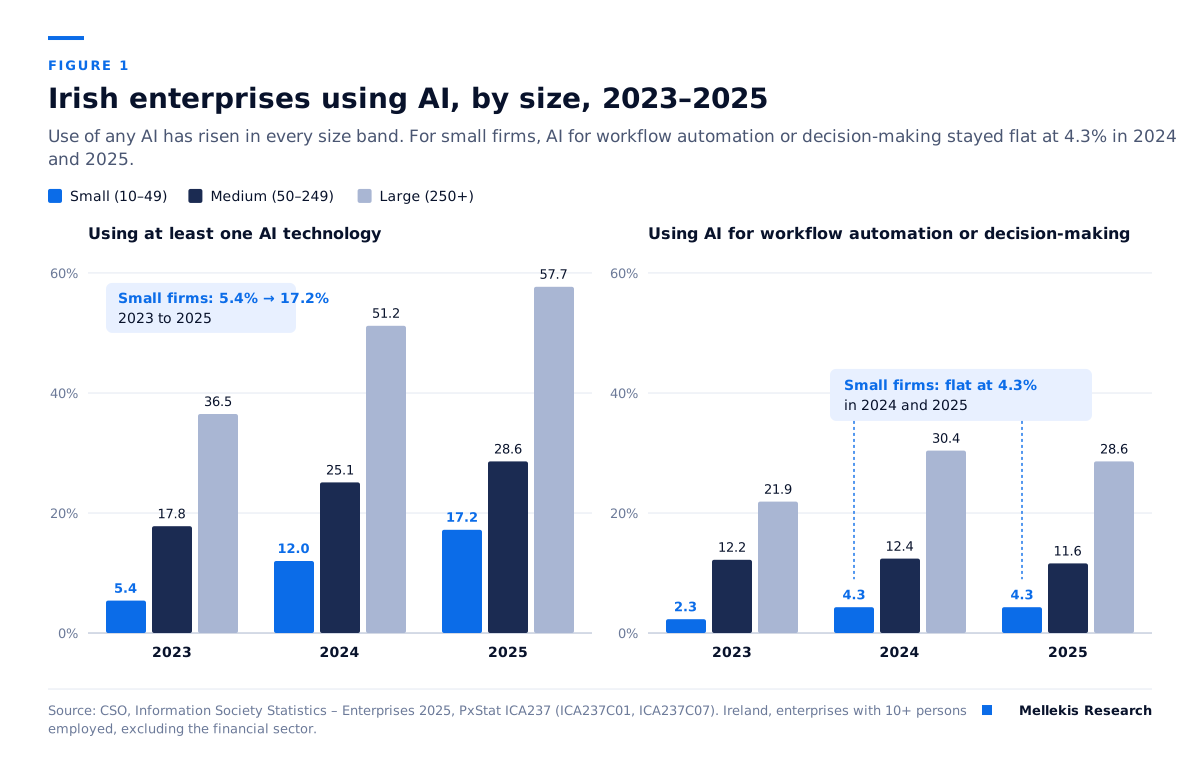
Those headlines are accurate, but they are not the most useful measure. The more useful question for an owner or COO is not whether firms use AI but how deeply. On that measure, official data tell a different story: AI is spreading across SMEs faster than it is spreading into the work itself. In Irish small enterprises, the share using AI to automate workflows or support decisions was 4.3% in 2024 and 4.3% in 2025 (CSO), while overall use climbed. Breadth is rising faster than depth.
Below we set out what the official statistics show, introduce a way to read them (our own Adoption Depth Index and Depth Score), and argue that the next gap between SMEs will be depth, not access. This 2026 edition uses the official data published up to 30 October 2026.
The headline: adoption has risen steeply since 2023
Each market measures adoption differently, so each gets its own number.
Ireland. The CSO's Information Society Statistics – Enterprises 2025 release shows use of at least one AI technology at 17.2% of small enterprises (10–49 employees), 28.6% of medium enterprises (50–249) and 57.7% of large enterprises (250+) in 2025. Two years earlier the figures were 5.4%, 17.8% and 36.5%.
| Ireland (CSO ICA237) | 2023 | 2024 | 2025 |
|---|---|---|---|
| Small (10–49): any AI | 5.4% | 12.0% | 17.2% |
| Medium (50–249): any AI | 17.8% | 25.1% | 28.6% |
| Small (10–49): AI for workflow automation or decision-making | 2.3% | 4.3% | 4.3% |
| Medium (50–249): AI for workflow automation or decision-making | 12.2% | 12.4% | 11.6% |
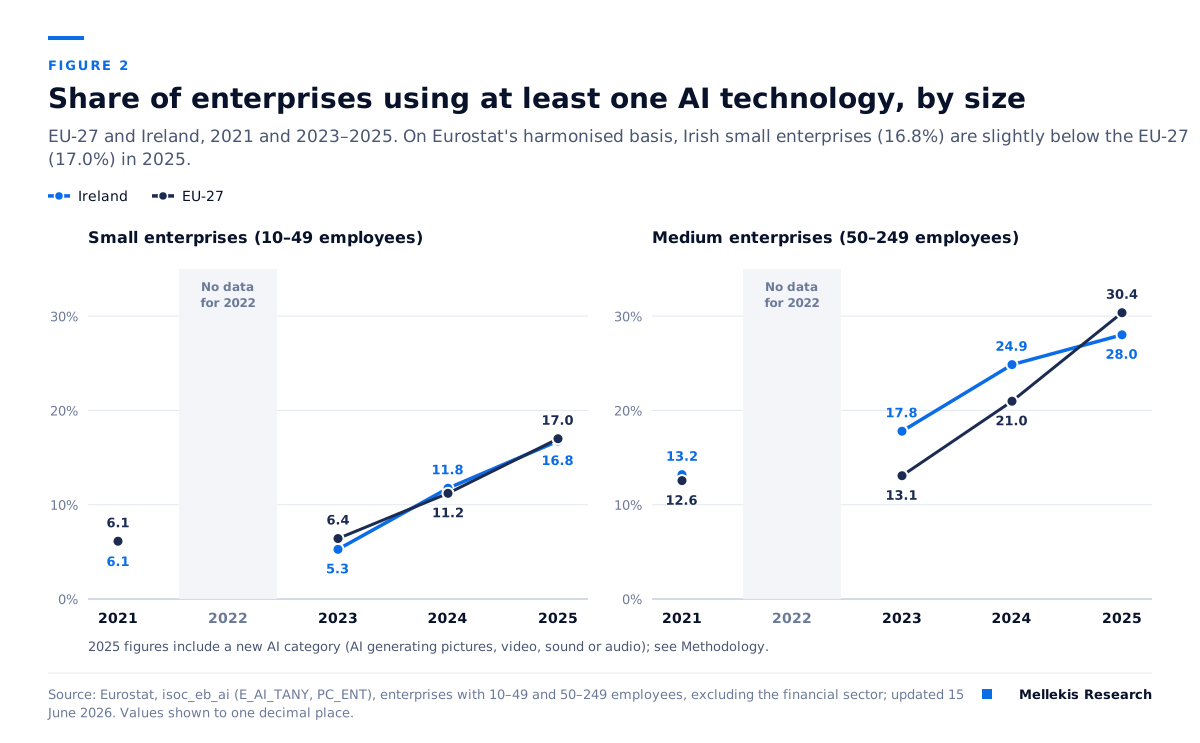
EU. Eurostat's enterprise survey shows the EU-27 share of small enterprises using AI at 17.0% in 2025 (6.4% in 2023) and medium enterprises at 30.4% (13.1% in 2023). On the same Eurostat basis, 16.8% of small and 28.0% of medium-sized Irish enterprises used AI in 2025: close to the EU-27 figure for small firms and somewhat below it for medium-sized ones. (Eurostat's figures for Ireland differ slightly from the CSO's; see Methodology.)
UK. The UK is not covered by Eurostat, so the ONS Business Insights and Conditions Survey (BICS) is the reference. The share of firms with 10–49 employees reporting that they do not currently use AI fell from 78.9% in September 2023 to 53.9% in September–October 2026. For firms with 50–99 employees it fell from 71.5% to 39.3%, and for 100–249 from 67.1% to 33.2%. A further 10.0% of small firms answer "not sure".
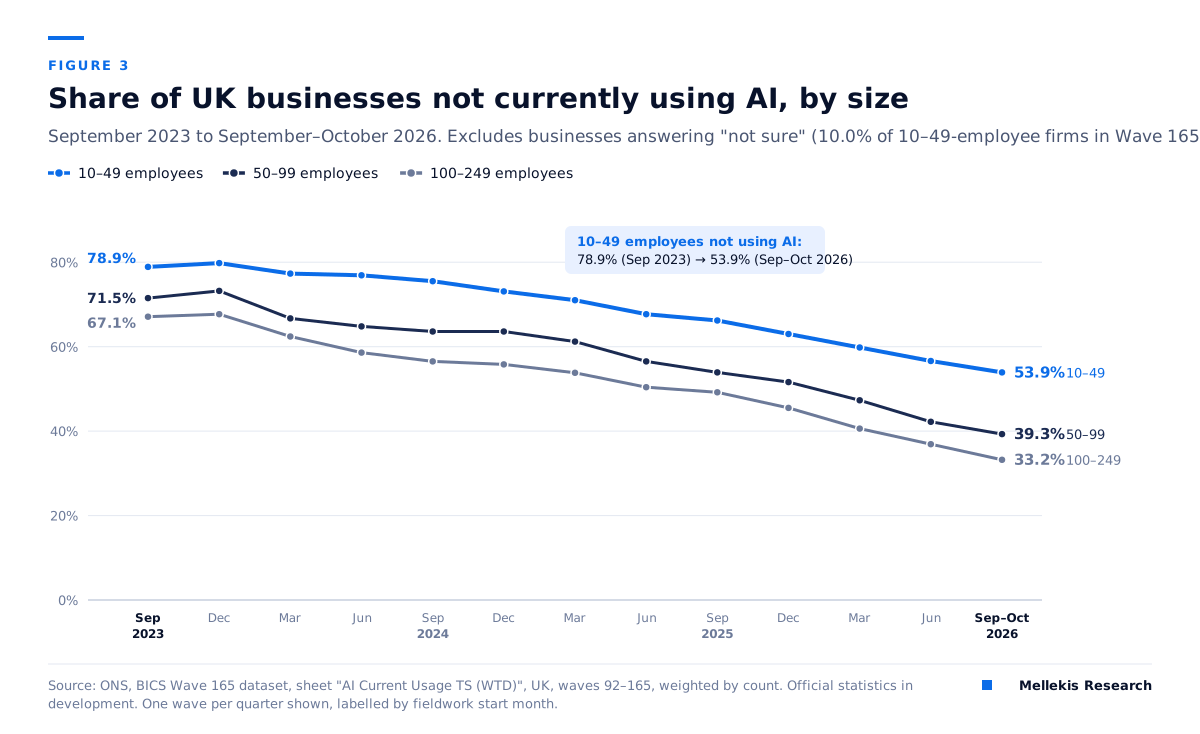
These figures come from different surveys and are not directly comparable. What they share is direction: in every market and size band, AI use has risen steeply since 2023.
Wide, not deep: the Adoption Depth Index
"Uses AI" covers a wide range. A firm where two people draft emails with a chatbot counts the same as one whose invoice approvals run through an AI-assisted workflow. Official surveys can't fully separate the two, but they collect enough detail to approximate depth.
| Level | What it means | Closest official proxy |
|---|---|---|
| 0. Not using | No AI technology in use | Eurostat E_AI_TX; ONS "does not currently use AI" |
| 1. Using | At least one AI technology | Eurostat E_AI_TANY; CSO ICA237 "any AI" |
| 2. Combining | Two or more AI technologies | Eurostat E_AI_TGE2 |
| 3. Embedding | AI automates workflows or supports decisions | Eurostat E_AI_TPA ("AI-based software robotic process automation"); CSO ICA237C07, the national equivalent. No UK equivalent |
| 4. Governing | Named ownership, trained staff, clear rules of use | No official indicator. The ONS question on AI training covers one element (trained staff), for UK firms only |
The levels are an interpretive order, not a nested hierarchy in the data. Eurostat's indicators overlap rather than stack: a firm can use AI to automate a workflow (our level 3 proxy) while using only one AI technology, so it would not appear in the level 2 proxy. In 2023, for example, more Irish small enterprises used AI for workflow automation or decision-making (2.3%) than used two or more AI technologies (1.9%) (Eurostat). The workflow indicator also measures one specific technology type, so it will not capture every way AI is built into a process. We do not assign any figures to level 4, because no official indicator exists for it.
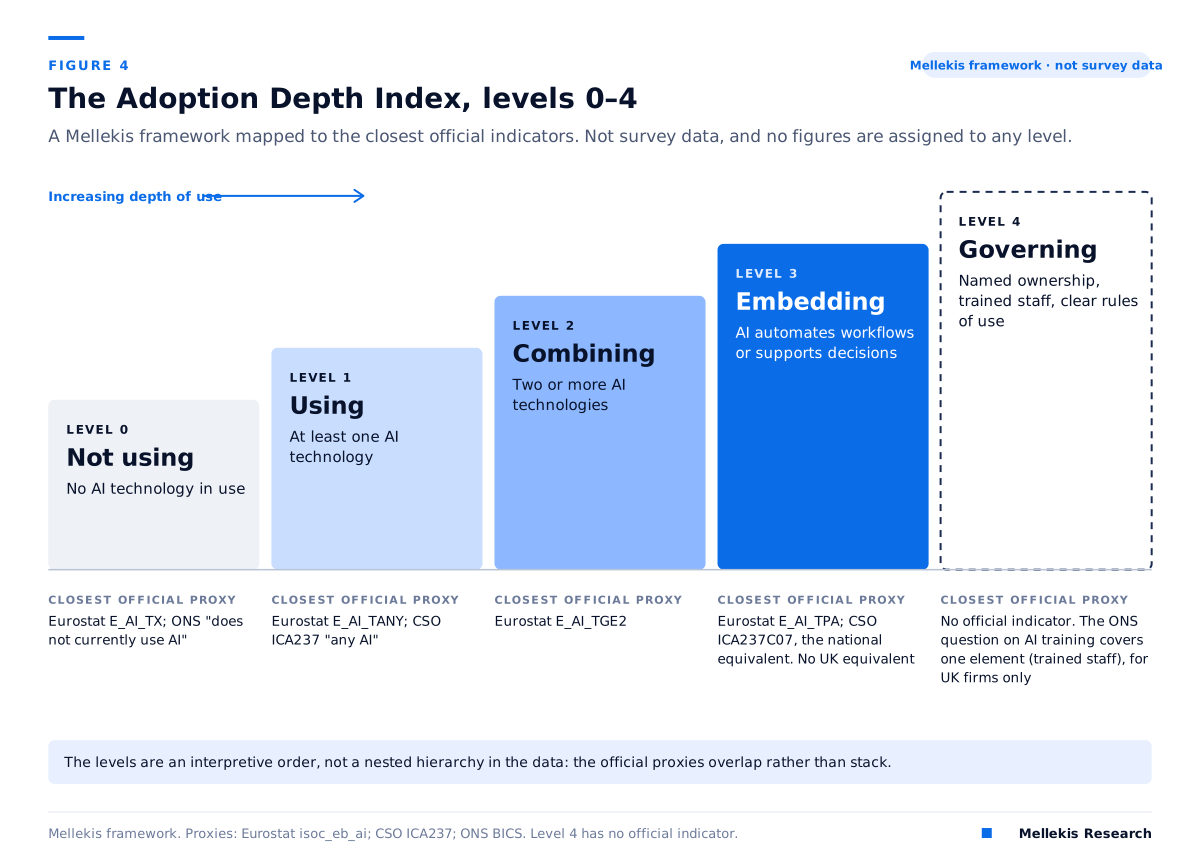
Two things stand out when the official data are read this way.
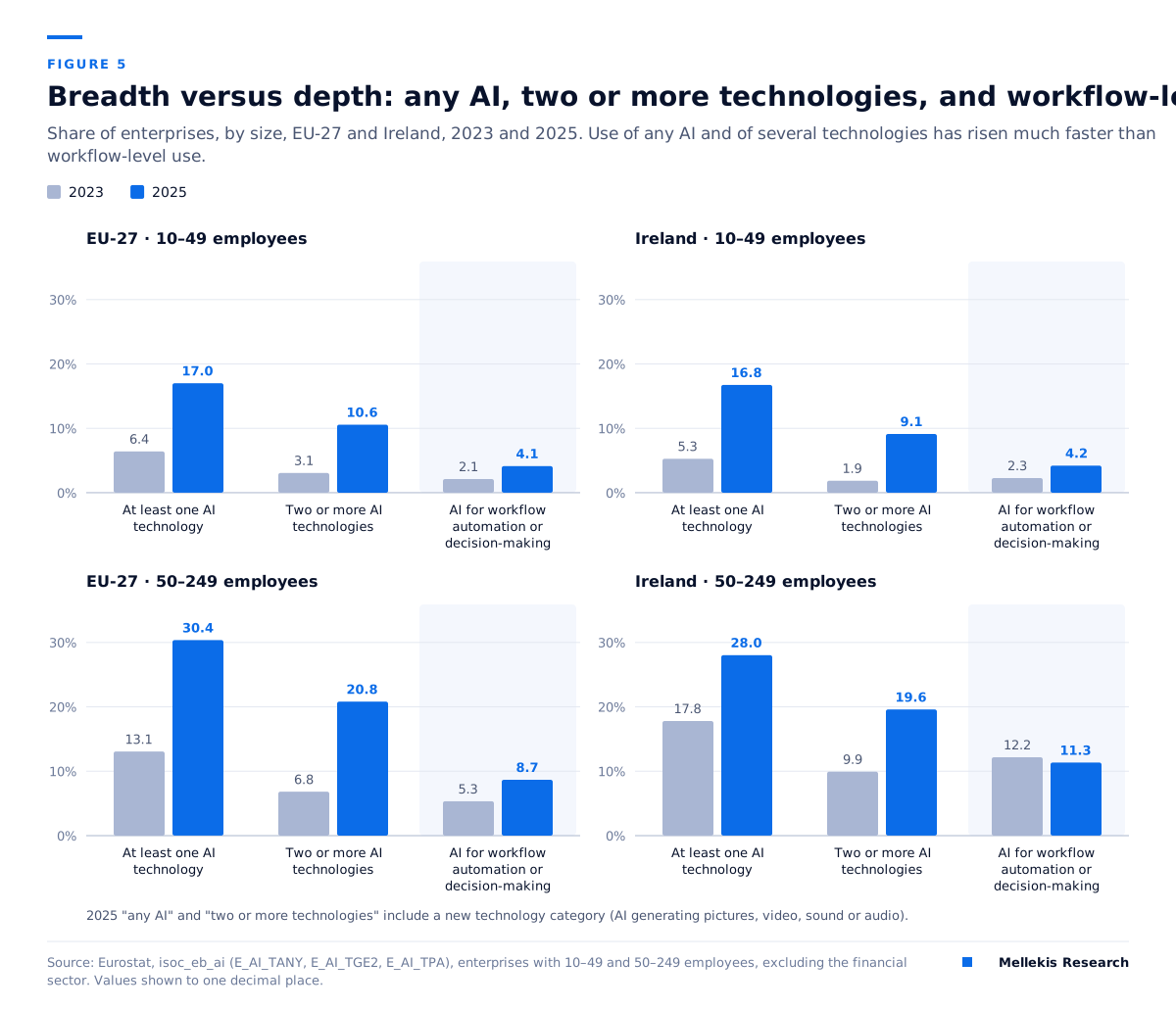
First, level 2 is rising quickly. The share of EU small enterprises using two or more AI technologies went from 3.1% in 2023 to 10.6% in 2025; in Ireland it went from 1.9% to 9.1% (Eurostat). Part of the 2025 figure reflects Eurostat's wider list of technologies: a firm that generates both text and images now counts as using two.
Second, level 3 is not keeping pace. EU small enterprises using AI to automate workflows or assist decisions went from 2.1% in 2023 to 4.1% in 2025. In Ireland the figure was 4.2% in both 2024 and 2025 (Eurostat), in line with the CSO's 4.3% in both years.
The Depth Score
| Depth Score (Mellekis calculation from Eurostat isoc_eb_ai) | 2021 | 2023 | 2024 | 2025 |
|---|---|---|---|---|
| EU-27, 10–49 employees | 34.0% | 33.1% | 27.0% | 24.3% |
| EU-27, 50–249 employees | 40.4% | 40.9% | 36.3% | 28.6% |
| Ireland, 10–49 employees | 31.2% | 43.1% | 36.0% | 25.1% |
| Ireland, 50–249 employees | 44.4% | 68.4% | 49.4% | 40.5% |
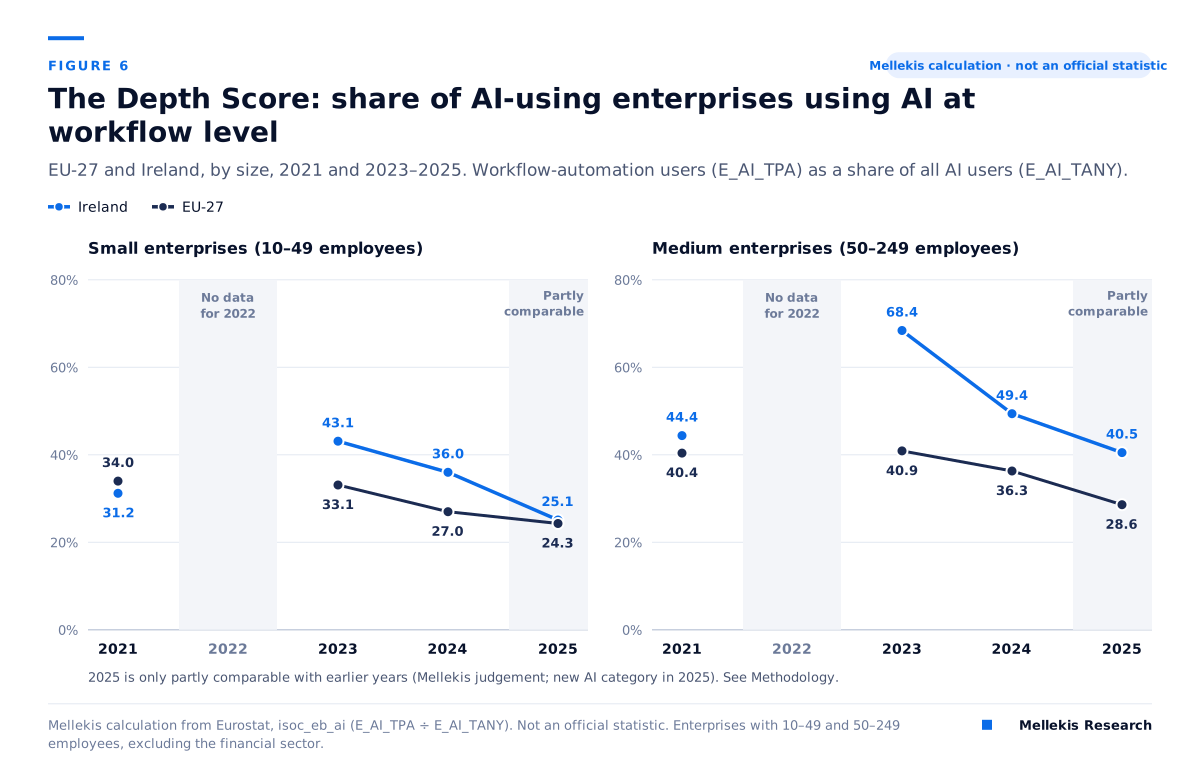
The direction is clear. In 2023, roughly one in three EU small enterprises that used AI were using it at workflow level (level 3). By 2025 it was roughly one in four. The number of firms using AI is growing faster than the number using it at workflow level. (The survey samples different firms each year, so it cannot show whether individual firms are moving to a higher level.) Part of the 2025 fall is likely to reflect Eurostat counting a new category of generative AI for the first time (see Methodology), but the pattern was already visible in 2024, before that change. The Irish medium-sized series is volatile, and we would not build an argument on any single year of it.
Where depth is happening
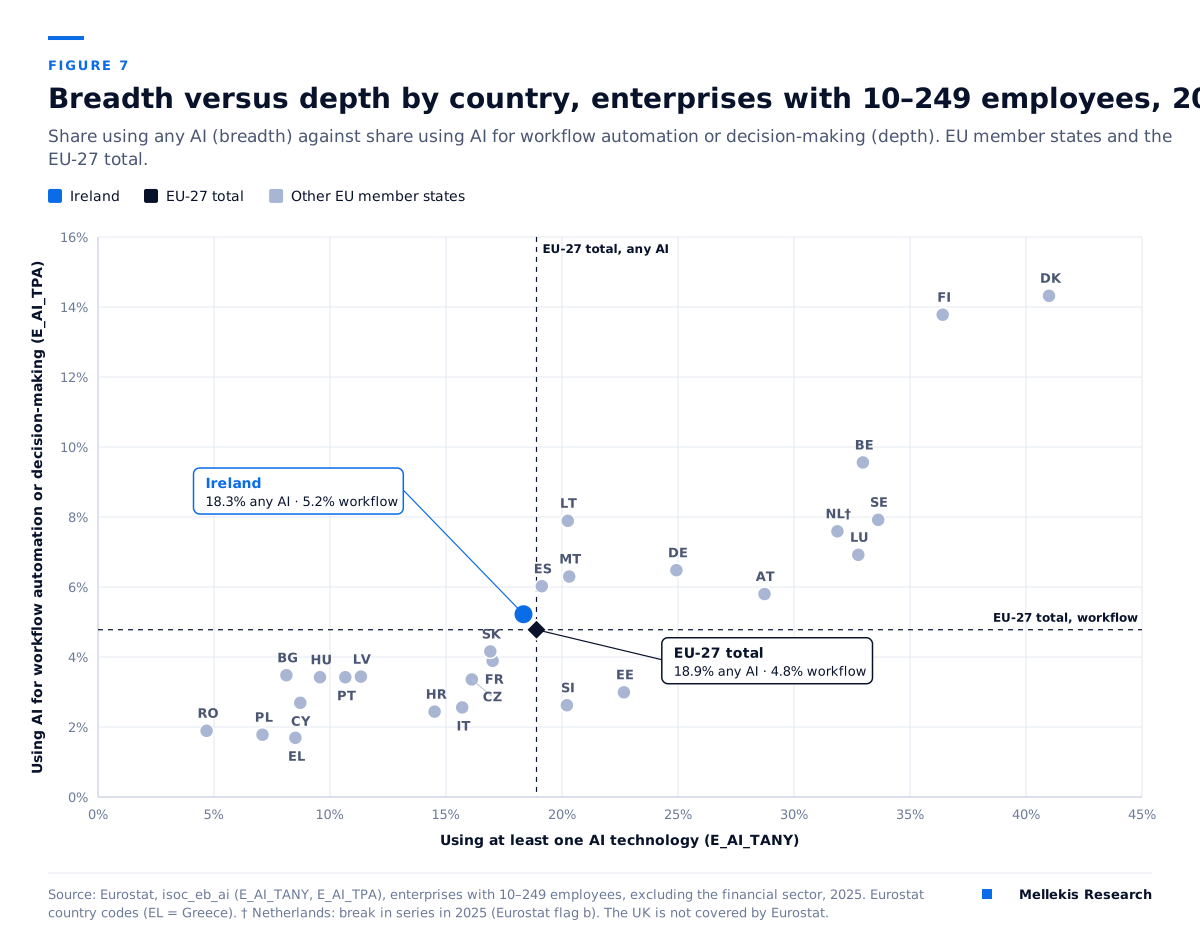
Breadth and depth do not always travel together. Among EU enterprises with 10–249 employees in 2025, Denmark (41.0% any AI; 14.3% workflow-level) and Finland (36.4%; 13.8%) lead on both. Sweden (33.6%; 7.9%) and the Netherlands (31.9%; 7.6%) have similar breadth but much less depth, with Depth Scores of about 24%, slightly below the EU-27 figure of 25.3%. (Eurostat flags a break in series for the Netherlands in 2025.)
Ireland is mid-table on breadth (14th of 27 member states; 18.3% against an EU-27 figure of 18.9%) and slightly above the EU-27 figure on depth, with a Depth Score of 28.5% against 25.3%. The gap is small, and it could widen or close.
What SMEs use AI for: the back office first
The purposes data show where AI is landing inside firms. Among AI-using enterprises with 10–249 employees in 2025, 37.9% in Ireland used AI for business administration or management, against 30.0% across the EU-27. Irish AI users also report higher shares for ICT security and for R&D or innovation. The reverse holds for marketing and sales: 25.7% in Ireland against 34.4% in the EU-27 (Eurostat). The CSO's own figures point the same way: business administration was the most common AI purpose among Irish small enterprises (6.3%) and, narrowly ahead of ICT services (11.8%), among medium-sized enterprises (12.2%) in 2025, measured as a share of all enterprises in each band (CSO, ICA238).
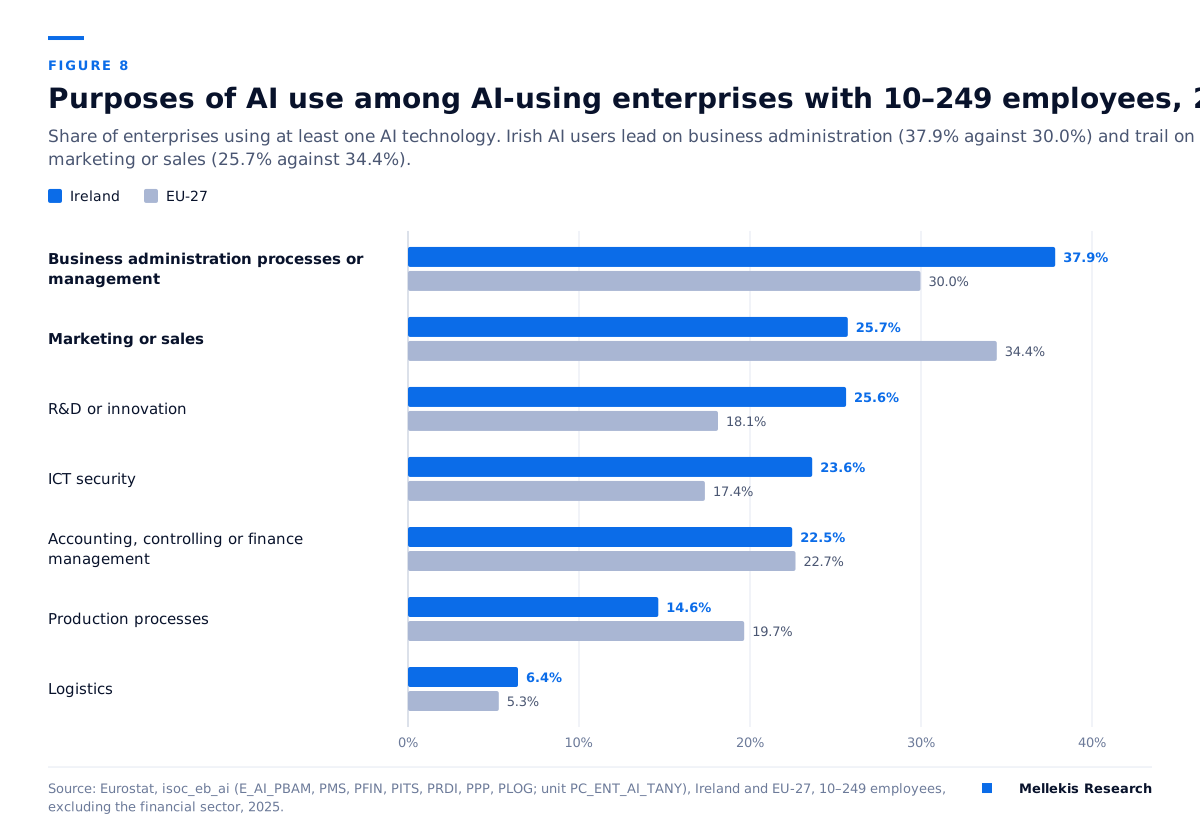
Our view: this is a sensible place to start. Administration is where much repetitive, rules-based work sits and where time saved is relatively easy to measure, so it is a practical place to move from level 2 to level 3. The question is whether firms treat it as individual productivity tricks or as processes to redesign.
The UK picture: limited use, thin training
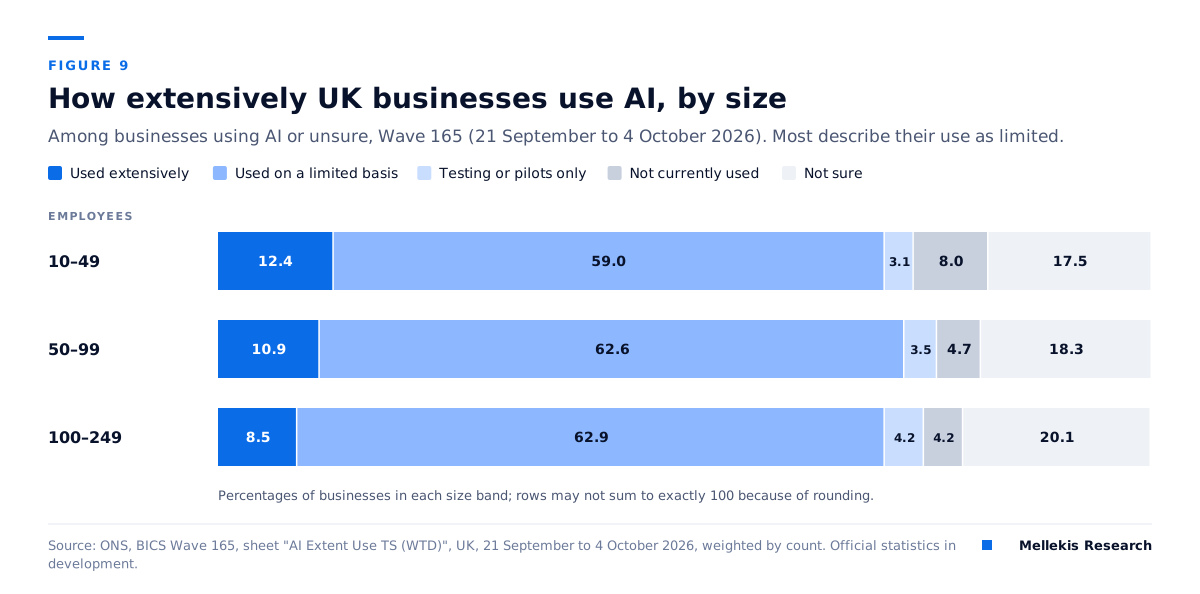
The ONS asks UK firms how extensively they use AI. In Wave 165 (fieldwork 21 September to 4 October 2026), among firms with 10–49 employees that use AI or are unsure whether they do, 12.4% said they use it extensively and 59.0% on a limited basis. A further 17.5% are not sure. In the 50–99 and 100–249 bands, "limited" is above 62%.
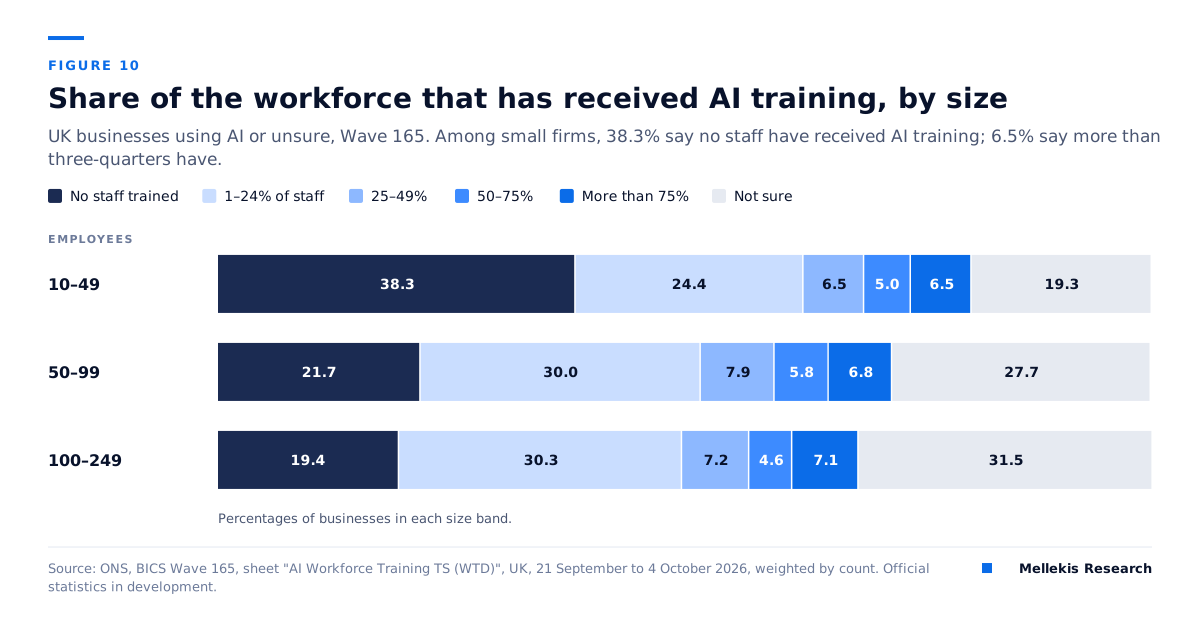
Training points the same way. Among the same group of small firms, 38.3% said no staff had received AI training, and only 6.5% said more than three-quarters of their workforce had. In the 50–99 and 100–249 bands, around one in five report no training (21.7% and 19.4%), but these firms are also more often unsure (27.7% and 31.5%), and the share with more than three-quarters trained is similar (6.8% and 7.1%). In our framework, level 4 depends on staff who know when to rely on the tools and when not to.
What's holding firms back: expertise, not cost
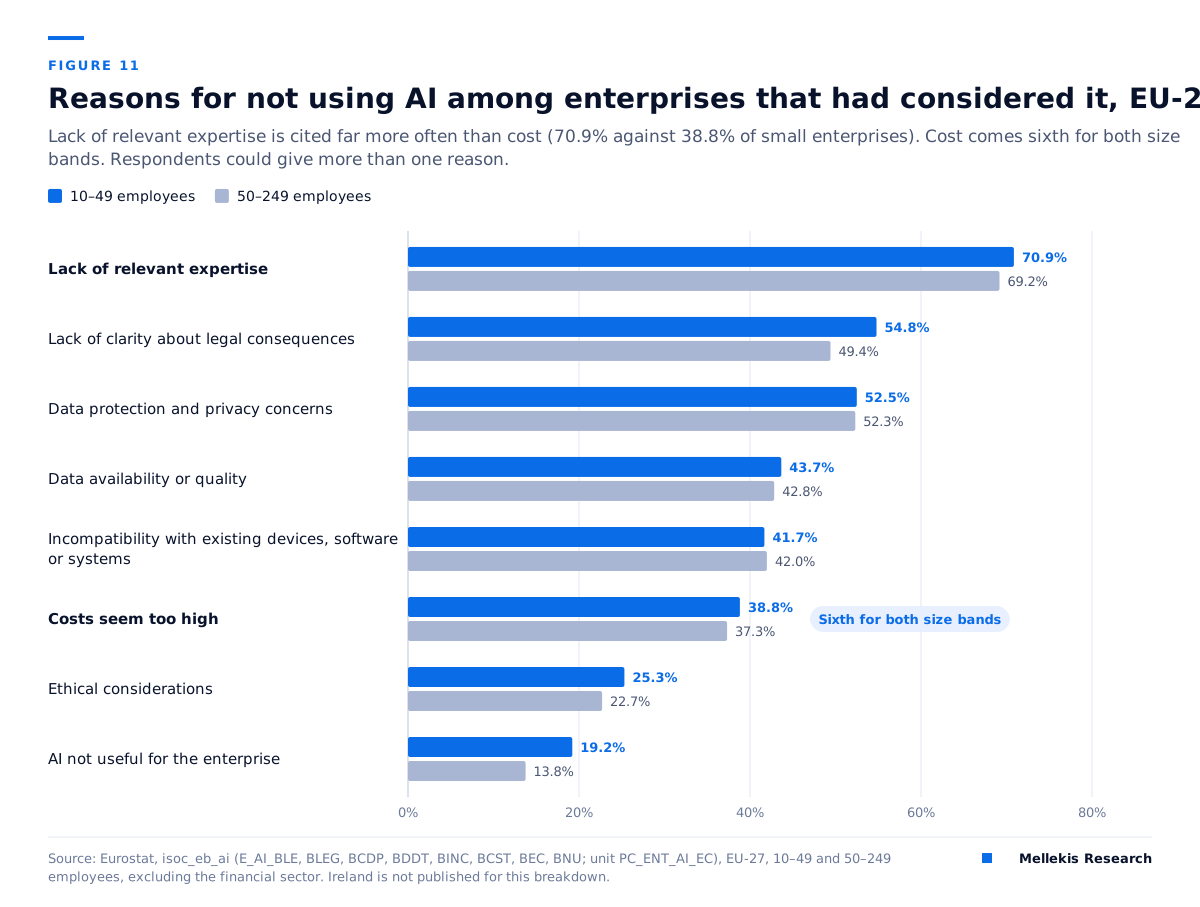
Eurostat asks enterprises that have considered AI but don't use it why not. Among EU small enterprises in that position in 2025, the most common reason was a lack of relevant expertise (70.9%). It was followed by a lack of clarity about legal consequences (54.8%), data protection and privacy concerns (52.5%), and data availability or quality (43.7%). Cost came sixth, at 38.8%. Medium-sized enterprises gave a similar ranking: expertise first (69.2%), then data protection (52.3%) and legal clarity (49.4%), with cost sixth (37.3%).
What this means for SME leaders
Our reading of the data leads to four conclusions.
1. Stop counting adoption; start measuring depth. "Do our people use AI?" is now a low bar. The better question is which processes AI has changed, and what is measurably different as a result. An internal Depth Score (the share of your AI use that sits inside a defined workflow) is a more honest progress measure than licence counts.
2. Treat expertise as the scarce resource. Among EU small firms that had considered AI but not adopted it, a lack of expertise was cited far more often than cost (70.9% against 38.8%). Eurostat does not publish this breakdown for Ireland, and the UK survey does not ask the same question. That means deliberate training, a named owner for each AI-enabled process, and time to redesign the work.
3. Start where SMEs already are. Administration is where Irish SMEs in particular are concentrating and, in our view, where depth is most achievable. A single administrative process with a measured baseline gives a firm evidence on whether deeper use pays off before it commits to wider changes.
4. Build governance in at level 3, not after it. Concerns about legal clarity and data protection rank high among EU firms that considered AI but don't use it. Rules of use, human review of outputs and training belong with the first embedded workflow, not the tenth.
Our expectation, which the data cannot yet test, is that the SMEs that pull ahead over the next two years will be those that went deep, deliberately, in the right places, rather than simply those that adopted first.
Methodology and sources
- Eurostat, Artificial intelligence by size class of enterprise (isoc_eb_ai), dataset updated 15 June 2026, extracted 30 October 2026 via the Eurostat API. Enterprises with 10 or more employees in manufacturing, utilities, construction and selected services, excluding finance and insurance (NACE Rev. 2 sections C to J, L to N and group 95.1). Size bands used: 10–49, 50–249 and 10–249 employees. Percentages are of all enterprises in the band (unit PC_ENT) unless stated otherwise. Purpose shares quoted in the text and shown in Figure 8 are of AI-using enterprises (PC_ENT_AI_TANY); barriers are of enterprises that had ever considered using AI (PC_ENT_AI_EC). Dataset DOI: 10.2908/ISOC_EB_AI. These are sample-survey estimates. We have not tested differences for statistical significance, so small gaps (for example, Ireland's 18.3% against the EU-27's 18.9%) should be read with caution.
- The 2025 change in what counts as AI. In 2025 Eurostat added a new technology to its AI question: AI generating pictures, videos, sound or audio (E_AI_TPVSG; 8.1% of EU small enterprises in 2025). Eurostat notes that this "is a new category, not present in the 2024 questionnaire, therefore there is no data for that year". The 2025 "any AI" (E_AI_TANY), "no AI" (E_AI_TX) and "two or more technologies" (E_AI_TGE2) indicators include it. So part of the 2024–25 rise in those indicators, and part of the 2025 fall in the Depth Score, may reflect the wider list rather than new adoption. Eurostat does not flag a break in series for the EU-27 or Ireland (it flags one for the Netherlands in 2025) and compares 2025 with 2024 directly. As a precaution, and as our own judgement rather than Eurostat's, we treat 2025 as only partly comparable with earlier years and base trend statements on 2023–2024 where we can.
- CSO, Information Society Statistics – Enterprises 2025, PxStat tables ICA237 and ICA238, released 6 February 2026, extracted 30 October 2026. Size classes: small (10–49), medium (50–249), large (250+). The CSO figures are also sample-survey estimates: about 4,000 enterprises are surveyed each year (a 55.1% response rate in 2025), and results are grossed up to the population.
- Eurostat and the CSO publish slightly different figures for Ireland. For example, Eurostat gives 16.75% of Irish small enterprises using AI in 2025 (16.8% rounded) and the CSO gives 17.2%. The CSO's background notes state that "Published results for Ireland may differ slightly from those in the Eurostat tables due to rounding." Some of the gaps we found are larger than rounding alone, up to 0.6 percentage points. We compared eight indicators (any AI, AI for workflow automation or decision-making, and six purposes of use) for small and medium enterprises in each year from 2023 to 2025: 48 comparisons in all. The CSO figure is higher in 43, equal in one and lower in four, and none of the lower ones differs by more than 0.04 points. Neither source documents the cause. Both cover enterprises with 10 or more persons employed in manufacturing, utilities, construction and selected services, excluding finance and insurance (see the NACE note below). Eurostat's table was last updated on 15 June 2026, after the CSO release of 6 February 2026. We use CSO figures for Ireland-only statements and Eurostat figures for any comparison with the EU, and we do not combine the two in one series.
- The UK is not covered by Eurostat. UK figures come from the ONS Business Insights and Conditions Survey (BICS), Wave 165 dataset (live period 21 September to 4 October 2026, released 8 October 2026), and the ONS bulletin of the same date. BICS is a voluntary, weighted survey (9,933 responses in Wave 165, a 25.7% response rate). Its estimates are official statistics in development. Its size bands (10–49, 50–99, 100–249), question wording and "not sure" option differ from Eurostat's, so UK figures are shown separately and not ranked against EU countries. Wave 165 is the most recent wave with AI questions at the time of writing; Wave 166 (published 22 October 2026) did not include them.
- Mellekis calculations and frameworks. The Depth Score is calculated by Mellekis from Eurostat figures (E_AI_TPA ÷ E_AI_TANY) and is not an official statistic. The Adoption Depth Index is a Mellekis analytical framework that maps official indicators to five levels of use (0–4); it is not a survey category.
- NACE note. NACE Rev. 2 sections C to J and L to N, plus group 95.1 (repair of computers and communication equipment); Eurostat's aggregate code is C10-S951_X_K. The CSO's background notes list the same sections and describe its coverage of section M (divisions 69–75) as "selected sectors".
- Updates. Figures are the latest published as at 30 October 2026; any later releases will be added as dated "Latest data" notes rather than silent edits.
- About this analysis. Mellekis is an AI strategy, consulting and implementation agency, so we have a commercial interest in AI adoption. This analysis uses only the published official statistics listed above; it does not use client data or any Mellekis survey.
Frequently asked questions
What share of Irish SMEs use AI?
According to the CSO, 17.2% of small enterprises (10–49 employees) and 28.6% of medium enterprises (50–249 employees) in Ireland used at least one AI technology in 2025, up from 5.4% and 17.8% in 2023.
How does Ireland compare with the EU-27?
On breadth, Ireland is close to the EU-27 figure. Among enterprises with 10–249 employees in 2025, 18.3% in Ireland used AI against 18.9% across the EU-27 (Eurostat). On depth, Ireland is slightly ahead, with a Depth Score of 28.5% against 25.3% for the EU-27 (Mellekis calculation from Eurostat data).
How many UK businesses use AI?
The ONS reports that 38% of UK businesses with 10 or more employees were using at least one AI technology in September 2026. Among firms with 10–49 employees, 53.9% said they do not currently use AI and a further 10.0% were not sure.
What is the Depth Score?
It is a Mellekis measure, calculated from Eurostat data, of the share of AI-using enterprises that use AI to automate workflows or support decisions. It is not an official statistic.
Why don't more SMEs use AI?
Among EU small enterprises that had considered AI but weren't using it in 2025, the most cited reason was a lack of relevant expertise (70.9%), ahead of unclear legal consequences (54.8%), data protection concerns (52.5%) and cost (38.8%) (Eurostat).
Do generative AI tools count in these figures?
Yes. Eurostat's indicators include AI that generates written or spoken language, and from 2025 also AI that generates pictures, video or sound. The ONS separately counts text generation using large language models and visual content creation.
Mellekis Research
The state of AI adoption in Irish, UK and EU SMEs, 2026: wide, not deep